Medical Imaging Career Guide
DMS vs. MRI - Which Medical Imaging Career Is Right for You?
Compare Diagnostic Medical Sonography and Magnetic Resonance Imaging, including imaging technology, patient care, workplace expectations, and Beckfield College’s associate-degree pathways.
Medical imaging helps healthcare providers examine structures and processes inside the body. Diagnostic Medical Sonography, commonly called DMS or ultrasound, and Magnetic Resonance Imaging, commonly called MRI, both produce images without ionizing radiation.
However, these imaging fields use different technologies and require different scanning techniques, safety procedures, patient-care approaches, and professional skills.
If you are considering a medical imaging career, the right choice is not simply the field that sounds more technical. It is the pathway that best matches how you want to work with patients, equipment, anatomy, safety procedures, and clinical teams.
Quick Answer
What Is the Main Difference Between DMS and MRI?
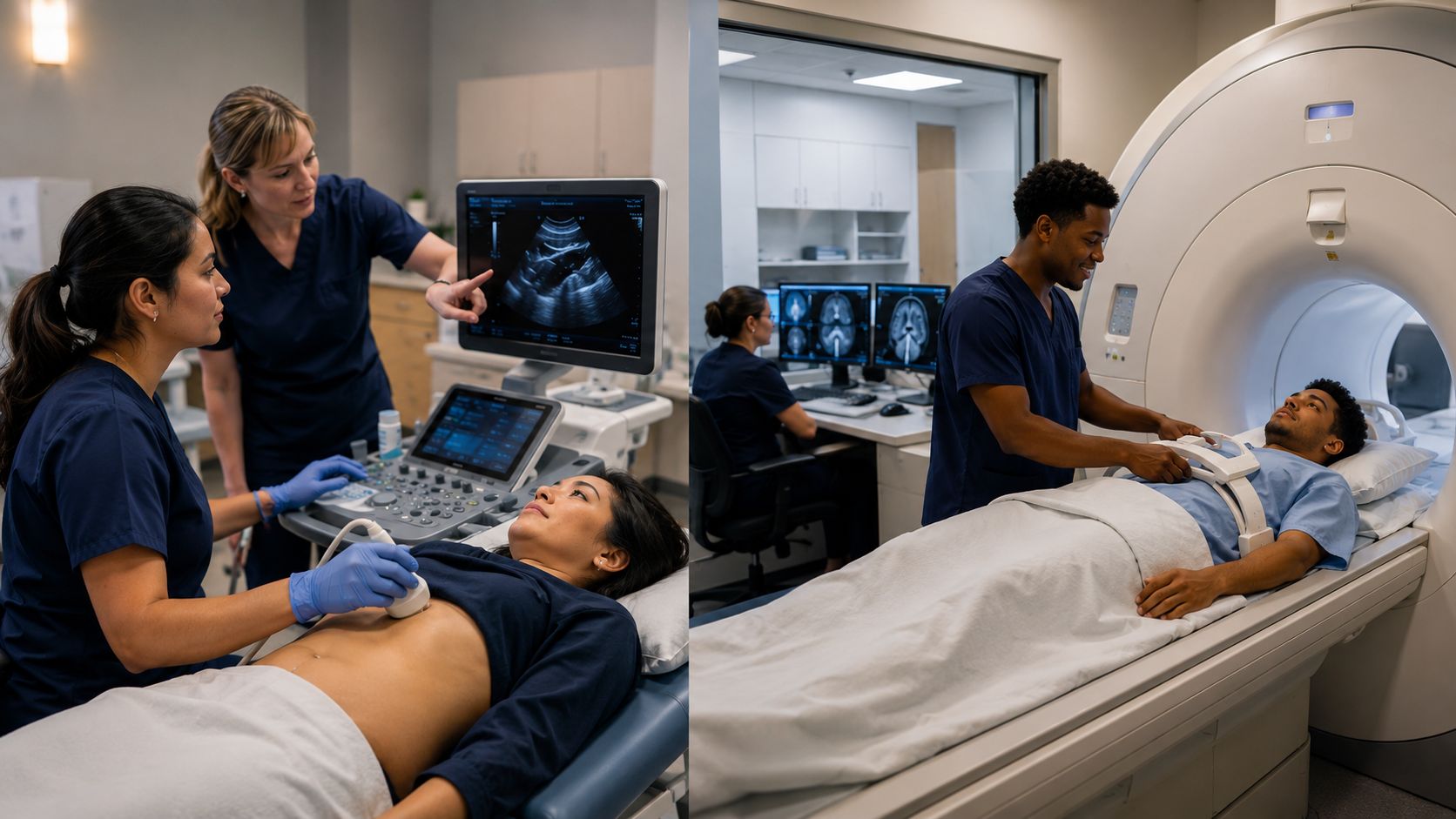
Diagnostic Medical Sonography uses high-frequency sound waves and a handheld transducer to create images in real time. MRI uses a strong magnetic field, radiofrequency energy, specialized coils, and computer processing to produce detailed image sequences.
DMS may fit someone who prefers continuous, hands-on scanning and real-time adjustments. MRI may fit someone who prefers protocol-based imaging, cross-sectional anatomy, detailed safety screening, and operating a large fixed scanner.
Neither career is universally better or easier. Each requires a different combination of technical ability, patient care, communication, critical thinking, and attention to safety.
Diagnostic Medical Sonography
What Is Diagnostic Medical Sonography?
Diagnostic Medical Sonography uses high-frequency sound waves to create images of organs, tissues, blood flow, and other structures inside the body. A sonographer moves a handheld transducer over the area being examined while watching and evaluating images on a monitor.
Because ultrasound produces images in real time, the sonographer continually adjusts the examination based on the patient’s anatomy, clinical history, positioning, and the images obtained.
Sonographers do not independently diagnose patients. Their images, measurements, observations, and technical documentation support interpretation by a physician or another appropriately authorized healthcare provider.
Common DMS Responsibilities
- Review examination orders and relevant patient history
- Explain procedures and correctly position patients
- Operate ultrasound equipment and adjust imaging controls
- Obtain and evaluate diagnostic-quality images
- Record measurements and technical observations
- Follow privacy, infection-control, and safety procedures
DMS May Appeal to You If You…
- Enjoy hands-on scanning and frequent patient interaction
- Like making real-time technical adjustments
- Are interested in anatomy, pathology, and ultrasound physics
- Can adapt to different patients and clinical questions
- Are comfortable performing precise, physically active work
Magnetic Resonance Imaging
What Is Magnetic Resonance Imaging?
Magnetic Resonance Imaging uses a strong magnetic field, radiofrequency energy, specialized coils, and computer processing to create detailed images of structures inside the body.
MRI technologists screen patients and others entering the MRI environment for potential safety risks. They position patients, select or adapt imaging protocols within their authorized role, operate the scanner, monitor patients, and evaluate images for technical quality.
Some MRI examinations take longer than other imaging procedures, and patients may need to remain still inside the scanner. Clear communication and attentive monitoring are especially important when a patient is anxious, uncomfortable, unable to remain still, or has an implant or medical history requiring additional safety review.
Common MRI Responsibilities
- Conduct and document thorough MRI safety screening
- Explain examinations and correctly position patients
- Select and perform appropriate imaging protocols
- Monitor and communicate with patients during scans
- Evaluate images for coverage, artifacts, and technical quality
- Follow magnetic-field, privacy, and emergency procedures
MRI May Appeal to You If You…
- Enjoy detailed imaging technology and cross-sectional anatomy
- Take safety screening and procedural consistency seriously
- Can support patients during longer examinations
- Like identifying and correcting image-quality problems
- Prefer structured protocols and a controlled environment
Side-by-Side Comparison
DMS vs. MRI: Key Differences
The following comparison shows how the two medical imaging professions generally differ. Specific responsibilities vary by employer, examination type, credentials, location, and scope of practice.
| Feature | Diagnostic Medical Sonography | Magnetic Resonance Imaging |
|---|---|---|
| Technology | High-frequency sound waves | Strong magnetic field, radiofrequency energy, and computer processing |
| Ionizing radiation | No | No |
| Image acquisition | The sonographer manually guides a transducer and adjusts the examination in real time. | The technologist positions the patient, uses specialized coils, and acquires planned image sequences. |
| Patient interaction | Often continuous and hands-on throughout image acquisition. | Includes screening, positioning, monitoring, and communication throughout the examination. |
| Safety emphasis | Patient identification, infection control, ergonomics, and examination-specific precautions. | Magnetic-field screening, implant and device review, controlled access, and examination-specific precautions. |
| Common areas | May include abdominal, obstetric, gynecologic, and vascular imaging, depending on training and credentials. | May include the brain, spine, joints, abdomen, pelvis, and other anatomy, depending on protocols and practice setting. |
| Equipment | Room-based or portable ultrasound systems | A large fixed scanner in a controlled MRI environment |
| Work style | Hands-on, operator-dependent scanning with continuous adjustments | Protocol-driven scanning with detailed safety preparation and image-sequence evaluation |
Shared Responsibilities
What Do DMS and MRI Have in Common?
Although the technologies differ, both professions combine technical knowledge with direct patient care. Professionals in either field must communicate clearly, protect patient privacy, follow safety standards, produce consistent images, document their work, and collaborate with healthcare professionals.
Patient Care
Explaining procedures, positioning patients, and responding to individual needs.
Anatomy
Understanding body structures and how they appear through the imaging modality.
Image Quality
Recognizing whether images meet technical and procedural expectations.
Teamwork
Communicating with physicians, imaging professionals, and clinical staff.
Safety
Following modality-specific standards, infection control, and privacy procedures.
Professionalism
Maintaining accurate documentation and appropriate communication.
Potential workplaces may include hospitals, outpatient imaging centers, physician offices, and specialty practices. Roles, schedules, credential expectations, and scope of practice vary by employer, location, and individual qualifications.
Preparing for the Profession
Education, Clinical Training, and Certification
Both pathways require specialized education and supervised practice. Coursework may include anatomy, patient care, imaging principles, safety, professional communication, and modality-specific procedures. Clinical education gives students opportunities to apply classroom and laboratory learning in healthcare environments under supervision.
Certification pathways are not identical for DMS and MRI. Eligibility depends on the credentialing organization, education completed, examination pathway, clinical requirements, and other current rules.
Important Credentialing Information
Completing an educational program does not automatically provide certification, licensure, employment, or eligibility for every credential. Prospective students should review Beckfield College’s current disclosures and the applicable credentialing organization’s requirements before enrolling and before applying for an examination.
Students considering sonography can review current credential information through the American Registry for Diagnostic Medical Sonography . Students considering MRI can review current credential information through the American Registry of Radiologic Technologists .
Explore Beckfield College
Compare Beckfield College’s Medical Imaging Programs
Ultrasound Pathway
Associate of Applied Science in Diagnostic Medical Sonography
Beckfield College’s DMS program focuses on ultrasound imaging, anatomy and physiology, pathology, patient care, image evaluation, laboratory learning, and clinical education.
The program is offered at the Florence, Kentucky campus and is designed to support preparation for entry-level sonography responsibilities and applicable credentialing pathways.
- Real-time ultrasound imaging
- Hands-on transducer operation
- Patient care and positioning
- Laboratory and clinical education
MRI Pathway
Associate of Applied Science in Magnetic Resonance Imaging
Beckfield College’s MRI program focuses on MRI procedures, cross-sectional anatomy, patient care, magnetic-resonance safety, imaging principles, laboratory or simulation learning, and supervised clinical education.
The approximately 24-month program is offered at the Florence, Kentucky campus and is designed to prepare students for entry-level MRI responsibilities and applicable ARRT MRI certification pathways.
- Cross-sectional anatomy
- MRI procedures and protocols
- Magnetic-resonance safety
- Laboratory and clinical education
Program length may vary based on transfer credit, enrollment status, course scheduling, and successful completion of program requirements. Program availability, curriculum, admissions requirements, clinical placement requirements, and credentialing pathways are subject to change. Review the current Beckfield College Academic Catalog and applicable program disclosures for complete information.
Finding Your Fit
How Do You Decide Between DMS and MRI?
Consider which daily work style feels more natural. Would you rather guide a handheld transducer while continuously adapting a real-time examination? Or would you rather work with a large scanner, detailed safety screening, and carefully planned image sequences?
You May Lean Toward DMS If:
- You prefer continuous hands-on scanning.
- You enjoy making immediate imaging adjustments.
- You want frequent interaction throughout an examination.
- You are comfortable with operator-dependent imaging.
You May Lean Toward MRI If:
- You enjoy protocol-based technology.
- You are interested in cross-sectional anatomy.
- You value detailed safety screening and consistency.
- You enjoy identifying artifacts and image-quality issues.
Compare the curriculum, admissions requirements, clinical expectations, credentialing pathways, and potential work environments. An admissions representative can explain Beckfield College’s programs, but your decision should reflect your interests, abilities, circumstances, and career goals.

Frequently Asked Questions
DMS vs. MRI FAQs
Do DMS and MRI use radiation?
Neither diagnostic ultrasound nor MRI uses ionizing radiation. Ultrasound uses high-frequency sound waves. MRI uses a strong magnetic field and radiofrequency energy. Each modality still has important safety procedures.
What is the main difference between ultrasound and MRI?
Ultrasound uses sound waves and a handheld transducer to create images in real time. MRI uses a strong magnetic field, radiofrequency energy, specialized coils, and computer processing to acquire detailed image sequences.
Which career involves more patient interaction?
Both involve meaningful patient care. Sonography interaction is often continuous and hands-on during image acquisition. MRI technologists interact with patients during safety screening, positioning, explanation, monitoring, and communication throughout the examination.
Is DMS easier than MRI?
Neither field is universally easier. DMS and MRI require different technical, academic, physical, and interpersonal skills. Reviewing each program’s curriculum can help you understand its expectations.
Can completing a program guarantee certification or a job?
No. Program completion does not guarantee eligibility for every credential, passage of an examination, licensure where applicable, employment, salary, or a particular career outcome.
Where are Beckfield College’s DMS and MRI programs offered?
Beckfield College identifies both associate-degree programs as campus-based programs offered in Florence, Kentucky. Confirm current delivery details and availability before enrolling.
How should I choose between DMS and MRI?
Consider whether you prefer hands-on, real-time ultrasound scanning or protocol-based MRI examinations involving detailed safety screening and planned image sequences. Compare the curriculum, clinical expectations, credentialing pathways, and potential work environments.
Take the Next Step
Explore a Future in Medical Imaging
DMS and MRI offer different ways to combine imaging technology, anatomy, patient care, and clinical problem-solving. Choose the pathway you want to explore.
Diagnostic Medical Sonography
Learn more about Beckfield College’s DMS-focused associate-degree pathway.
Magnetic Resonance Imaging
Learn more about Beckfield College’s MRI-focused associate-degree pathway.